
A QC Chemist’s Guide to Tablet Hardness Testing
Tablet hardness plays an important role in pharmaceutical quality control, helping manufacturers evaluate the mechanical strength and consistency of tablets. QC chemists use breaking-force measurements to monitor production and identify potential variations that may affect tablet quality.
This guide explains how tablet hardness testing works, why it matters, and what to consider when selecting a tablet hardness tester.
Why Tablet Hardness Matters
Tablet hardness refers to the force required to break a tablet under specified testing conditions. It provides useful information about tablet strength and manufacturing consistency.
Tablet hardness testing helps QC chemists:
- Evaluate resistance to breakage during handling and transportation.
- Monitor variations in tablet compression and manufacturing.
- Investigate potential changes in disintegration and dissolution performance.
Higher hardness does not always mean better quality. Tablets must meet their mechanical strength requirements while maintaining their intended performance.
How Is Tablet Hardness Measured?
A tablet hardness tester applies force to a tablet until it fractures, recording the breaking force in units such as newtons (N) or kilogram-force (kgf).
The general testing process involves selecting representative samples, positioning each tablet correctly, applying force until breakage, and comparing the results against established specifications.
Consistent sample handling, appropriate test conditions, and properly maintained instruments help support reproducible measurements.
How Does a Tablet Hardness Tester Work?
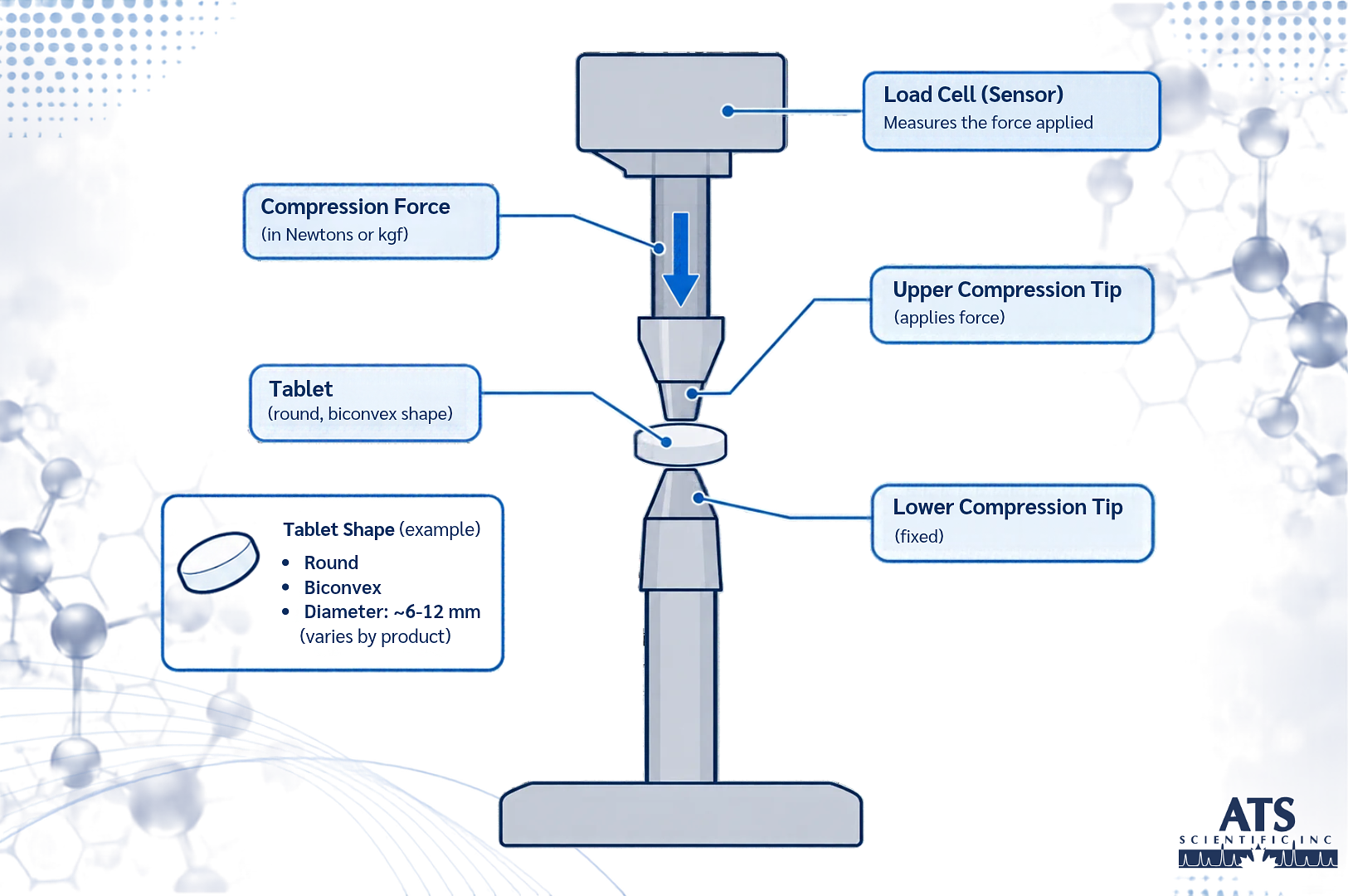
Although tablet hardness testers vary in design, most use a mechanical system to apply a controlled force to a tablet until it breaks. The instrument measures the force at the point of fracture and reports the result as the tablet’s breaking force.
The testing process typically involves four steps:
1. Tablet positioning
The tablet is placed between two contact points, often a fixed support and a movable jaw or probe. Correct positioning is important because the tablet’s orientation and contact points can affect the measured breaking force.
2. Controlled force application
A motor-driven mechanism, spring system, or other force-generating assembly moves the contact point toward the tablet. Depending on the instrument design, the tablet may be compressed between two opposing platens or between a moving probe and a fixed support.
3. Force measurement and fracture detection
As the contact point moves, the force applied to the tablet increases. A force sensor or load cell measures this force. When the tablet fractures, the instrument detects the corresponding change in force and records the breaking force.
4. Result display and reset
The measured value is displayed digitally or recorded electronically. In automated systems, the tester may also position samples, perform multiple measurements, calculate statistical results, and save data for quality control records.
What Happens Inside the Instrument?
The key components are the force-generating mechanism, contact assembly, force sensor, and control system. Together, they apply force, measure the tablet’s resistance, detect fracture, and convert the measurement into a readable result.
The exact mechanism depends on the model. Manual testers may rely on a hand-operated mechanism, while automated instruments typically use motorized movement and electronic measurement. Some systems also incorporate automatic tablet feeding and positioning to improve testing throughput and consistency.
What Affects Tablet Hardness?
Several factors can influence tablet breaking force:
- Compression force: Manufacturing settings affect how particles bond during tablet formation.
- Formulation: Ingredients such as binders and disintegrants influence tablet structure.
- Moisture content: Moisture can affect material properties and particle bonding.
- Tablet dimensions: Shape, thickness, and orientation can influence measured breaking force.
When results vary unexpectedly, QC chemists can investigate these factors alongside sampling procedures and instrument performance.
Choosing a Tablet Hardness Tester
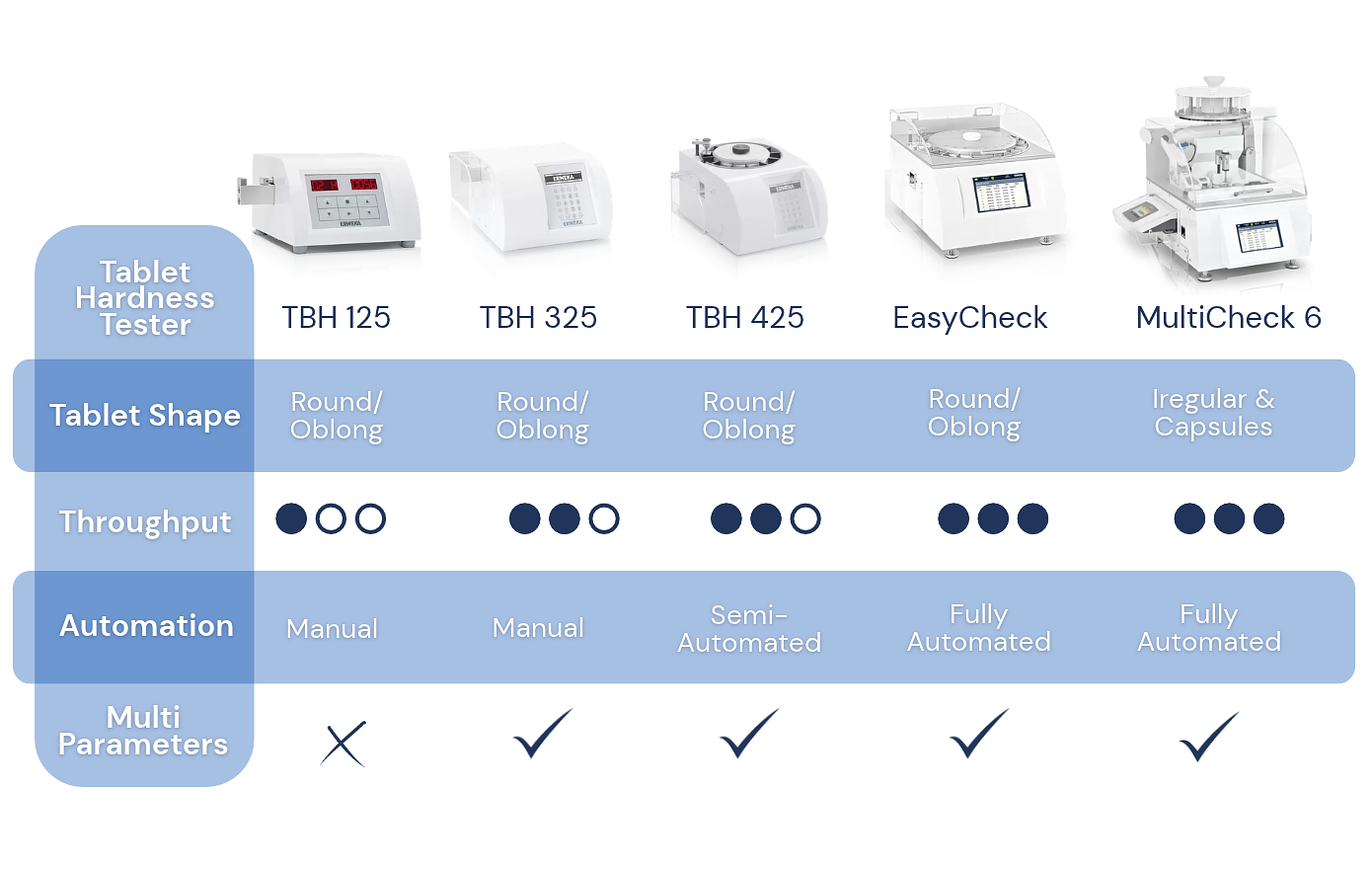
When selecting a tablet hardness tester, consider the measurement range, repeatability, tablet size compatibility, testing throughput, and data management requirements.
The right instrument should support the laboratory’s testing methods, sample volume, and quality procedures. Hardness measurements are also most informative when considered alongside other relevant tests, including friability, disintegration, and dissolution.
Looking for Pharmaceutical Testing Solutions?
Consistent tablet quality starts with appropriate testing methods and suitable laboratory equipment.
ATS Scientific supports laboratories in finding scientific instruments suited to their applications and quality control needs.
Contact ATS Scientific to discuss your laboratory equipment requirements.