
Quick Selection Guide
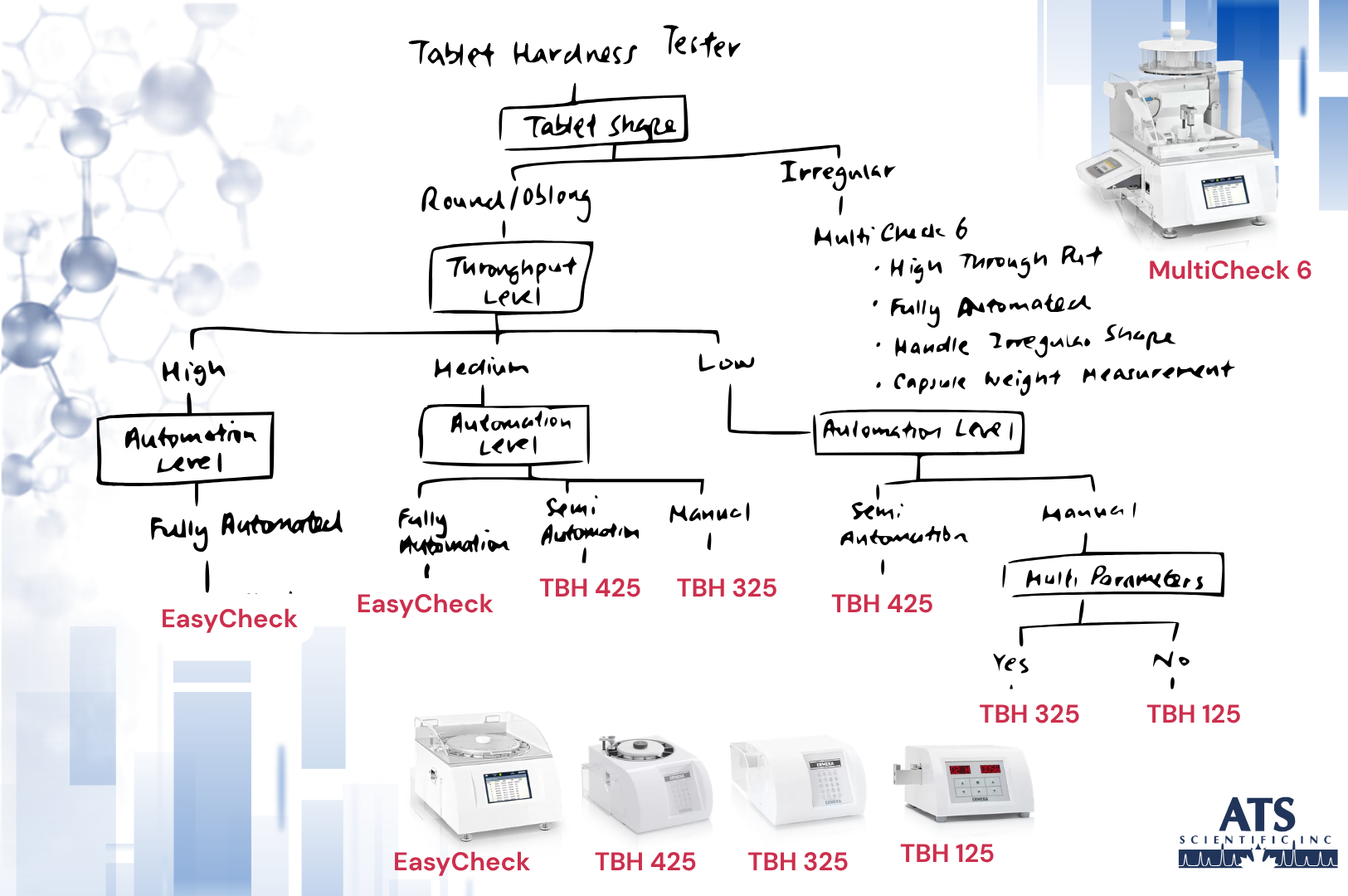
- Performs occasional testing with basic documentation → Choose TBH 125
- Performs manual routine testing with multiple parameters → Choose TBH 325
- Semi-automated testing for multiple tablet parameters → Choose TBH 425
- Requires automated testing for higher throughput and improved workflow efficiency → Choose EasyCheck
- Handles high-volume production testing with irregular tablet types and maximum automation → Choose MultiCheck 6
Introduction
Developing a successful drug involves much more than selecting the right active ingredient. Every tablet must also meet strict quality requirements before it reaches the patient.
One of the most important quality tests is tablet hardness.
If a tablet is too soft, it may break during packaging and transportation. If it is too hard, it may not dissolve as intended, which can affect how the medication performs.
When searching for a tablet hardness tester, many laboratories begin by comparing specifications. While these are important, they should not be the first thing you compare.
The best hardness tester depends on how your laboratory performs testing every day. A system designed for high-volume manufacturing may be unnecessary for a research laboratory, while a basic manual tester may not keep up with a busy production environment.
Before choosing a tablet hardness tester, ask yourself these five questions.
- How much operator involvement do you want?
- How many tablets do you test each day?
- What types of tablets do you manufacture?
- What documentation do you require?
- Will your workflow grow in the future?
1. How Much Automation Fits Your Workflow?
Manual Testing
Testing is simple and straightforward, with full control over every sample. The operator places each tablet into the instrument and starts every measurement manually.
- Lower equipment cost
- Simple operation
- Ideal for occasional testing
- Easy to learn
Recommended: TBH 125 and TBH 325
Semi-Automated Testing
The operator loads the sample, while the instrument automatically performs multiple measurements during a single test sequence. This reduces repetitive work while maintaining operator control.
- Faster than manual testing
- Measures multiple tablet parameters automatically
- Reduces operator workload
- Improves testing consistency
Recommended: TBH 425
Fully Automated Testing
The instrument automatically feeds tablets, performs measurements, records results, and prepares for the next sample with minimal operator involvement.
- Highest throughput
- Consistent testing
- Minimal operator intervention
- Improved workflow efficiency
Recommended: EasyCheck and MultiCheck 6
2. Is Your Testing Volume Increasing?
Low Throughput
If your laboratory only performs hardness testing occasionally, a simple manual tester is usually enough.
Recommended: TBH 125
Medium Throughput
Routine testing requires a faster workflow without moving to full automation.
Recommended: TBH 325 or TBH 425
High Throughput
Production environments often test hundreds or even thousands of tablets every day. Manual testing quickly becomes time-consuming. Fully automated systems help increase efficiency,
Recommended: EasyCheck or MultiCheck 6
3. What Types of Tablets Do You Test?
Different tablet shapes present different testing challenges.
Incorrect positioning can affect hardness results, especially for tablets with unusual shapes.
Round Tablets and Oblong Tablets
Round and Oblong tablets are the easiest to position and are compatible with all ERWEKA hardness testers.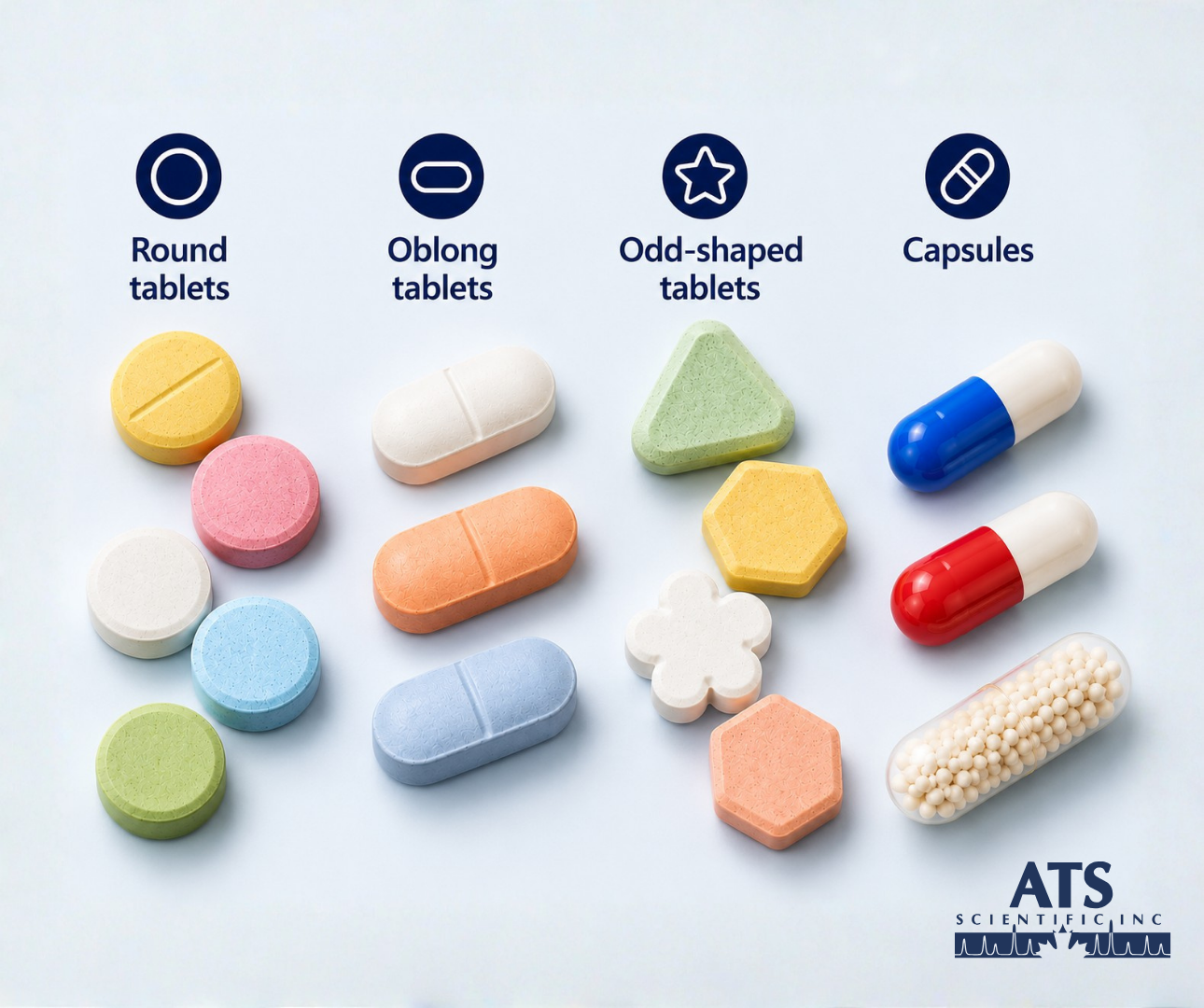
Compatible models:
Odd-Shaped Tablets
Irregular tablet shapes can be difficult to position consistently.
MultiCheck 6 uses advanced positioning technology to improve repeatability when testing complex tablet geometries.
Capsules
Some laboratories also need to test capsule weight alongside tablet measurements.
MultiCheck 6 supports capsule weight measurement, making it suitable for laboratories handling multiple dosage forms.
4. How Will You Manage Your Test Data?
Data management is becoming just as important as the measurement itself. The right documentation solution depends on your laboratory requirements.
Basic Documentation
For smaller laboratories, printed reports and manual record keeping may be sufficient.
Recommended: TBH 125
Digital Documentation
As testing volume increases, electronic records become easier to manage.
Features may include:
- Internal product memory
- Electronic records
- Network connectivity
Recommended: TBH 325 and TBH 425
Compliance & Data Integrity
Pharmaceutical manufacturing often requires compliance with 21 CFR Part 11. This includes secure electronic records, audit trails, and centralized data management.
Recommended: EasyCheck and MultiCheck 6
5. Is Your Lab Ready for Future Growth?
Choosing a hardness tester isn't only about today's workload. Consider where your laboratory may be in the next few years.
Stable Workflow
If your applications and production volume are unlikely to change, a manual or semi-automatic tester may continue to meet your needs.
Recommended: TBH 125, TBH 325 or TBH 425
Expanding Workflow
As production grows, manual testing can become a bottleneck. An automated system can help support increased throughput without significantly increasing operator workload.
Recommended: EasyCheck
Maximum Scalability
Large pharmaceutical manufacturers often need equipment that can support future expansion across multiple product lines.
Recommended: MultiCheck 6
Summary
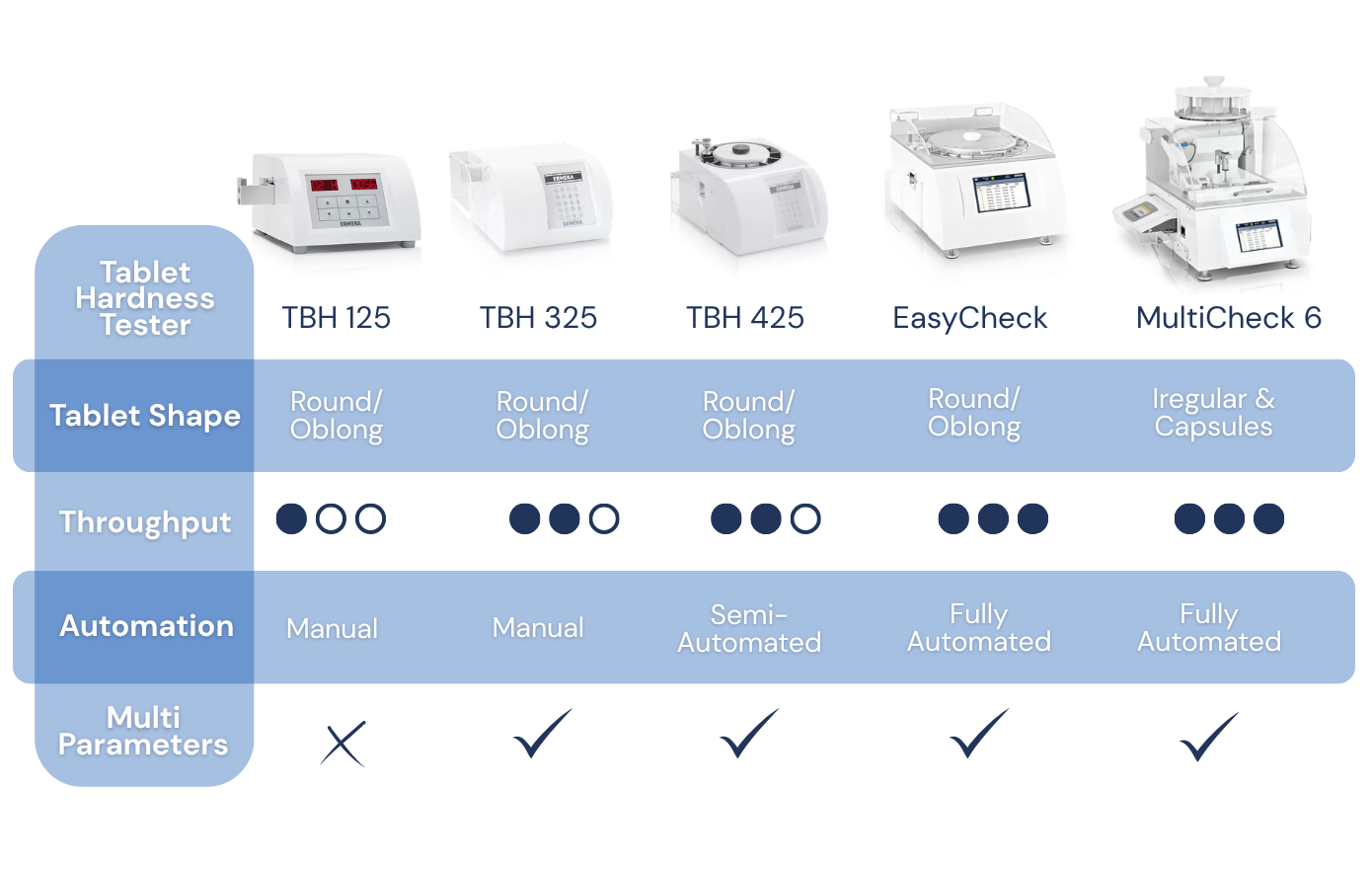
The best tablet hardness tester isn't the one with the longest specification sheet.
It's the one that fits the way your laboratory works every day.
Start by looking at your workflow. Once you understand those requirements, selecting the right hardness tester becomes much easier.