

There is no doubt that soil is a complex medium for the life of many microorganisms. Much like humans, microbes also need a balanced diet to thrive. They work hard in soil and decompose organic matter, keeping soil healthy, with nutrients available for crops.
What exactly makes soil “healthy”?
Having a carbon-to-nitrogen (C:N) ratio of 24 is considered the Goldilocks ratio for maintaining the most optimal microbial activity, residue decomposition, and overall health of soil.
A C:N ratio higher than 24:1 means that microbes will have to use nitrogen to break down the carbon-rich residue, making the nitrogen unavailable to the crops. Imagine, for instance, a soil with back-to-back rotations of corn with a C:N ratio of 57:1. In these conditions, the decomposition of organic matter will be slow and much of the nitrogen will be “tied up.” Conversely, a lower C:N ratio than 24:1 leads to much faster decomposition and might create nutrient leaching issues. This is why knowledge of the C:N ratio of soil is indispensable in agricultural planning for crop rotation, using cover crops, and other actions, in order to ensure nutrients such as nitrogen remain available.
With the C:N insight into soil being so essential, agricultural and soil laboratories need to process large sample volumes while maintaining high accuracy and reproducibility now, more than ever, hence, an inherent need to streamline these analyses for maximum efficiency. While traditional methods require aggressive chemicals and time-consuming analysis steps, modern laboratories increasingly rely on dry combustion elemental analysis (Dumas) to streamline their workflows and improve data quality.
Dry combustion (Dumas) with the CN 802
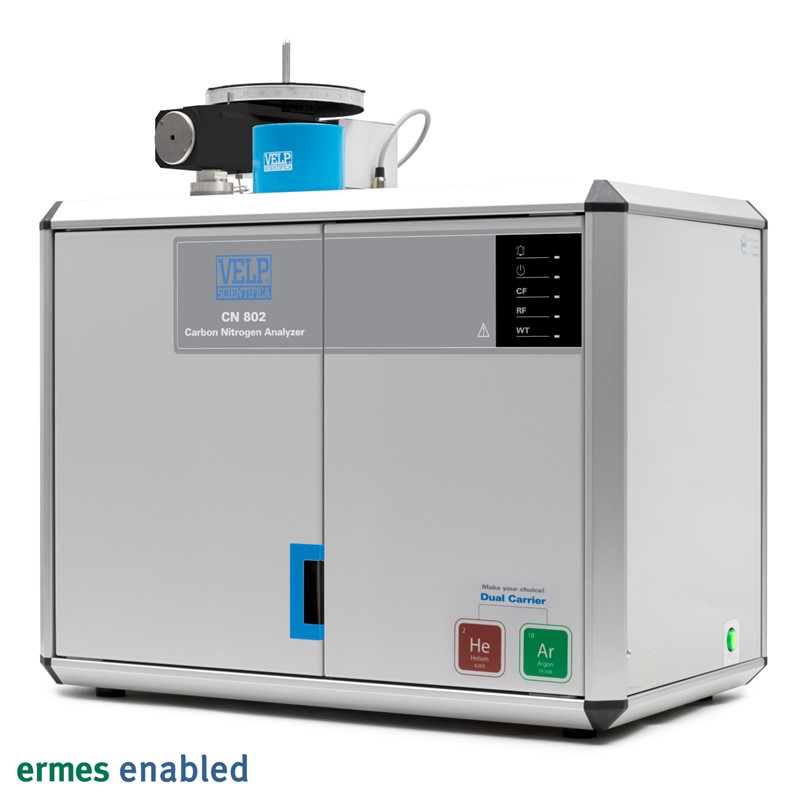 The VELP CN 802 Carbon and Nitrogen Analyzer is an elemental analyzer, applying the Dumas combustion method, and following official reference methods (e.g. ISO 10694, ISO 13878, EN13654-2) for the determination of carbon and nitrogen including but not limited to the all-important C:N ratio.
In this approach, soil samples are combusted at high temperatures to obtain elemental compounds. Water is then removed using two traps: physical and chemical. Upon removal of water, the elemental substances pass through a reduction furnace and CO₂ is obtained. The concentrations of CO₂ are measured using the VELP-exclusive Non-Dispersive HighSensIR™ detector and then converted to carbon quantity. Auto-regenerative CO2 absorbers, then let only the elemental nitrogen pass. LoGas™ innovative Thermal Conductivity Detector (TCD) measures the nitrogen content with no requirement for a reference gas. The procedure is fully automated by the intuitive CNSoft™ software. This design allows laboratories to move from sample to result in as little as three minutes per analysis, while maintaining excellent analytical performance.
Case study: Proven performance in real soil samples
The CN 802 was evaluated using soil and sediment reference materials as part of the WEPAL Proficiency Testing Program. Multiple soil types, including clay, sandy soil, and sediments were analyzed repeatedly. The results for both carbon and nitrogen fell well within the accepted statistical ranges. The results demonstrated ease of use, fast measurements (2 to 5 minutes), automatic calculation of the C:N ratio by the CNSoft™ software, and excellent repeatability and accuracy that meets with the demands of most laboratories. Moreover, the high productivity of the CN 802 and optional connectivity to the VELP Ermes Cloud Platform makes it ideal for high-throughput laboratories.
Accurate and reliable C:N ratio analysis of soil forms the foundation for understanding soil health, nutrient cycling, and agricultural planning. By combining fast analysis, high precision, and automation, the VELP CN 802 enables laboratories to be more efficient than ever in their response to high-demand C:N ratio analyses.
Click here to read the full case study:
Download Area, Application notes