The Hidden Risks of Dirty Oil: How Particle Contamination Damages Industrial Equipment
Introduction
Industrial lubricating oil plays an important role in protecting machinery. It reduces friction between moving components, helps dissipate heat, and carries contaminants away from critical surfaces.
However, even oil that appears clean can contain microscopic particles capable of affecting equipment performance. As machinery operates, these particles circulate through the lubrication system, creating repeated contact with gears, bearings, hydraulic components, and other moving parts.
Over time, particle contamination can accelerate component wear, reduce lubrication efficiency, and contribute to unexpected equipment downtime.
Where Does Particle Contamination in Oil Come From?
Oil contamination can develop at different stages of equipment operation. Even when fresh lubricant is introduced into a system, it can gradually accumulate particles from its surroundings and the machinery itself.
One common source is external contamination. Dust, dirt, and other airborne particles can enter through reservoir openings, worn seals, damaged filters, or during oil storage and handling. Industrial environments with high levels of dust or metal debris can increase the likelihood of contamination.
Another source comes from normal equipment operation. As gears, bearings, pumps, and other components move against one another, small fragments of metal and other materials can gradually wear away from their surfaces. These wear particles enter the oil and circulate throughout the system.
Contamination can also develop through oil degradation. Exposure to high temperatures, oxidation, and chemical reactions can contribute to the formation of deposits, sludge, and other insoluble materials. These substances can affect oil cleanliness and interfere with lubrication.
Regardless of their source, these particles can remain suspended in the oil and travel through the lubrication system. This creates a cycle in which contaminants repeatedly pass through critical equipment components.
How Does Dirty Oil Damage Industrial Equipment?
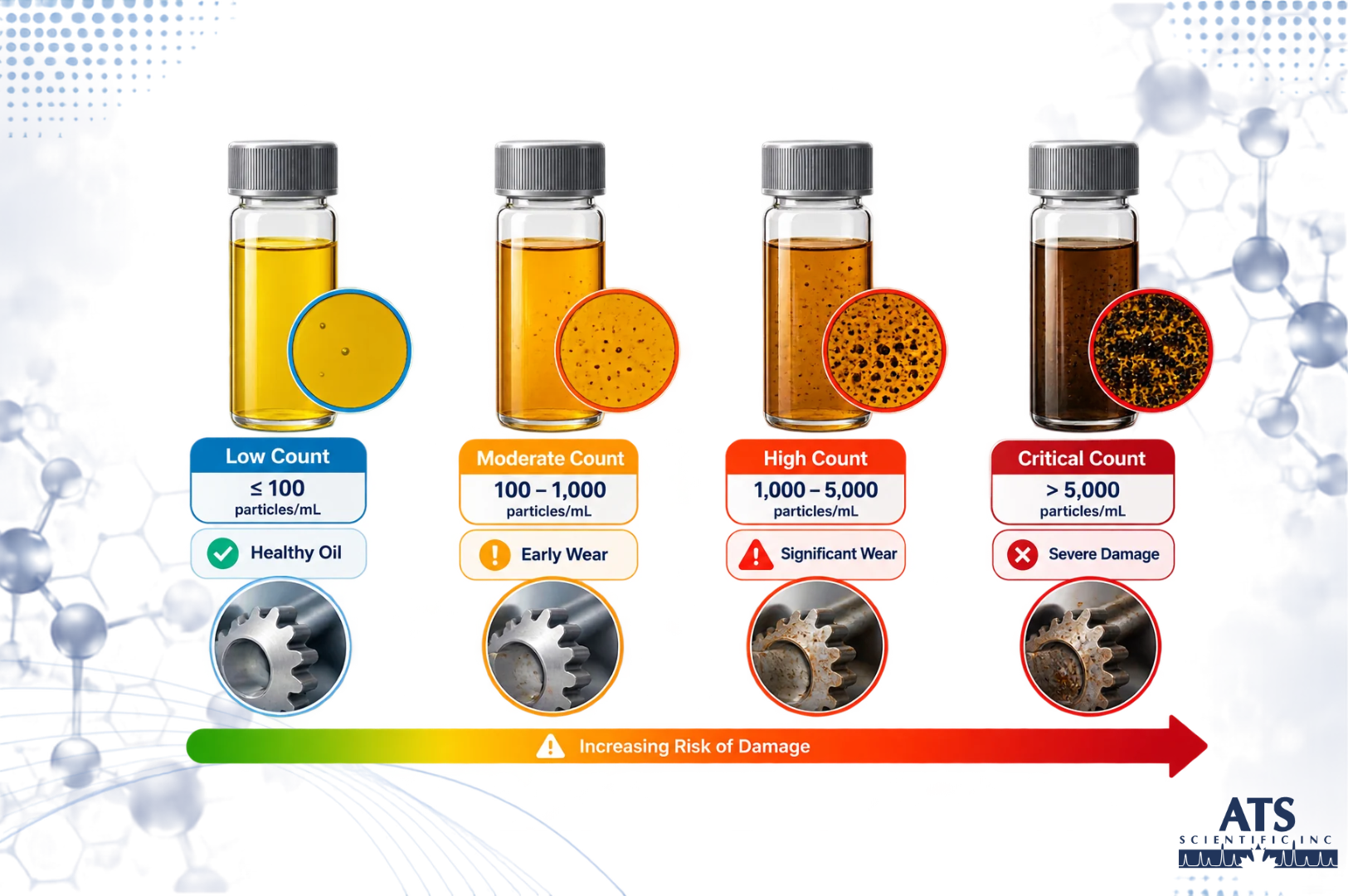
The presence of particles in lubricating oil can have a direct impact on the surfaces the oil is intended to protect.
When two metal surfaces move against each other, a lubricant film helps keep them separated and reduces direct contact. However, particles circulating in the oil can interfere with this protective layer.
Depending on their size, hardness, and concentration, particles can contribute to several types of wear.
Abrasive wear
Hard particles trapped between moving surfaces can act like tiny cutting tools. As they pass between gears, bearings, and other components, they can scratch surfaces, remove material, and gradually increase component clearance.
Surface fatigue
Repeated contact with contaminant particles can create small surface imperfections. Under continuous mechanical stress, these imperfections may develop into cracks, pitting, or surface deterioration, particularly in heavily loaded components such as gears and rolling bearings.
Blocked clearances and restricted flow
Small mechanical clearances are designed to allow precise movement and maintain proper lubrication. Particles that accumulate in these areas can interfere with component operation, restrict oil flow, or contribute to filter blockage.
As contamination increases, the consequences can extend beyond individual components. Accelerated wear may lead to increased maintenance requirements, reduced operating efficiency, and unexpected equipment failure.
This is why monitoring oil cleanliness is an important part of predictive maintenance. Identifying contamination before it causes significant damage gives maintenance teams an opportunity to investigate the source and take corrective action.
How Can Laboratories Determine Oil Contamination?
A sample may appear clear while still containing a significant number of microscopic particles. To evaluate contamination more accurately, laboratories use particle counting to measure the number and size distribution of particles in an oil sample.
Particle count analysis provides information about how many particles are present within different size ranges. This helps laboratories assess the cleanliness of the oil and monitor changes over time.
One commonly used classification system is ISO 4406, which expresses oil cleanliness using a three-part code. Each number represents the concentration of particles at or above specific particle sizes:
- 4 µm(c)
- 6 µm(c)
- 14 µm(c)
For example, an ISO cleanliness code of 18/16/13 represents the particle concentration ranges measured at these three size thresholds.
By comparing particle count results against equipment manufacturers' cleanliness requirements or established operating targets, laboratories can determine whether oil contamination levels are within acceptable limits.
Regular monitoring also makes it possible to identify changes in particle concentration. An increasing particle count may indicate developing wear, contamination entering the system, or problems with filtration.
However, particle counting measures particle concentration and size rather than identifying the chemical composition or exact source of each particle. Additional analytical techniques may be needed to investigate the nature and origin of contamination.
Monitoring Oil Cleanliness with PAMAS Particle Counting Systems
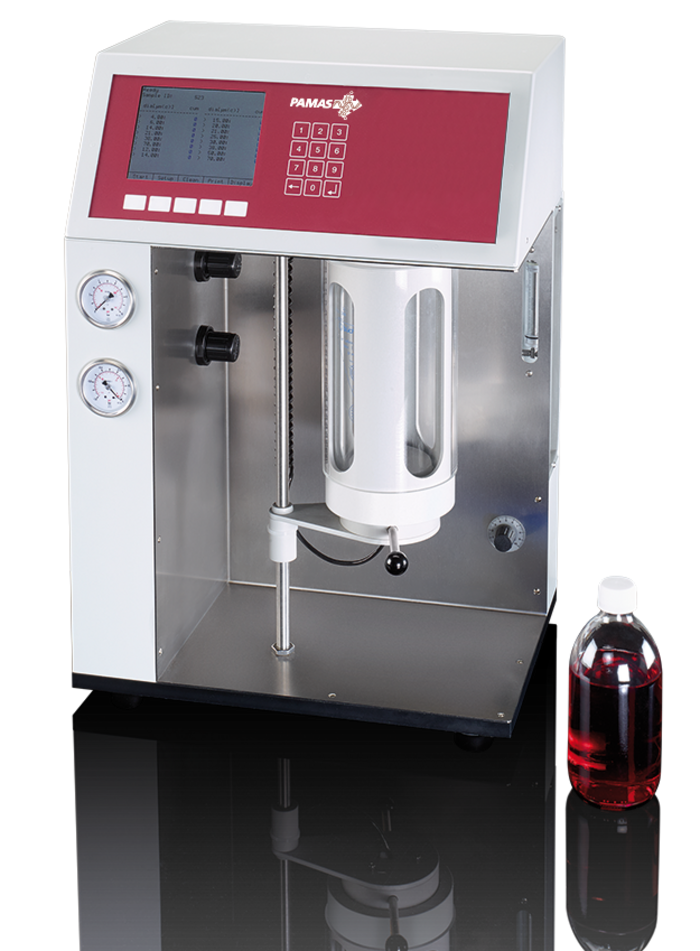
PAMAS particle counting systems are designed to measure particle concentration and size distribution in liquid samples, supporting contamination monitoring in industrial and hydraulic applications.
Using the light extinction principle, the systems detect particles as they pass through a measurement zone. When a particle moves through the light beam, it causes a change in the transmitted light intensity. The resulting signal is used to determine particle size, while the number of detected signals provides the particle count.
This allows laboratories to evaluate the cleanliness of oil samples and obtain quantitative results across different particle size ranges.
For industrial applications, particle counting can support:
- Oil cleanliness assessment: Determine particle concentrations and evaluate oil cleanliness against applicable standards such as ISO 4406.
- Condition monitoring: Track changes in particle concentration to identify potential contamination or developing wear.
- Filtration performance evaluation: Compare particle counts before and after filtration to assess how effectively a filtration system removes contaminants.
- Preventive maintenance: Provide measurable data to support maintenance decisions and help reduce the risk of contamination-related equipment damage.
By incorporating particle counting into routine oil analysis, laboratories can move beyond visual inspection and use measurable data to monitor lubricant condition.
Protect Equipment Through Better Oil Monitoring
Oil contamination is often difficult to detect by appearance alone, yet microscopic particles can contribute to significant wear over time. Understanding where these contaminants originate and how they affect machinery is an important part of maintaining industrial equipment.
Particle counting provides laboratories with a quantitative method to assess oil cleanliness, monitor contamination trends, and evaluate filtration performance.
With PAMAS particle counting systems, laboratories can obtain particle concentration and size distribution data to support oil condition monitoring and equipment maintenance programs.