
The most advanced particle size analyzer isn't always the right choice for your laboratory.
The best choice depends on your material, particle size range, sample volume, and analysis requirements.
For powder processing and material characterization, routine applications may require different capabilities than advanced particle characterization or sub-micron analysis. The right analyzer should match what you need to measure and how your laboratory works.
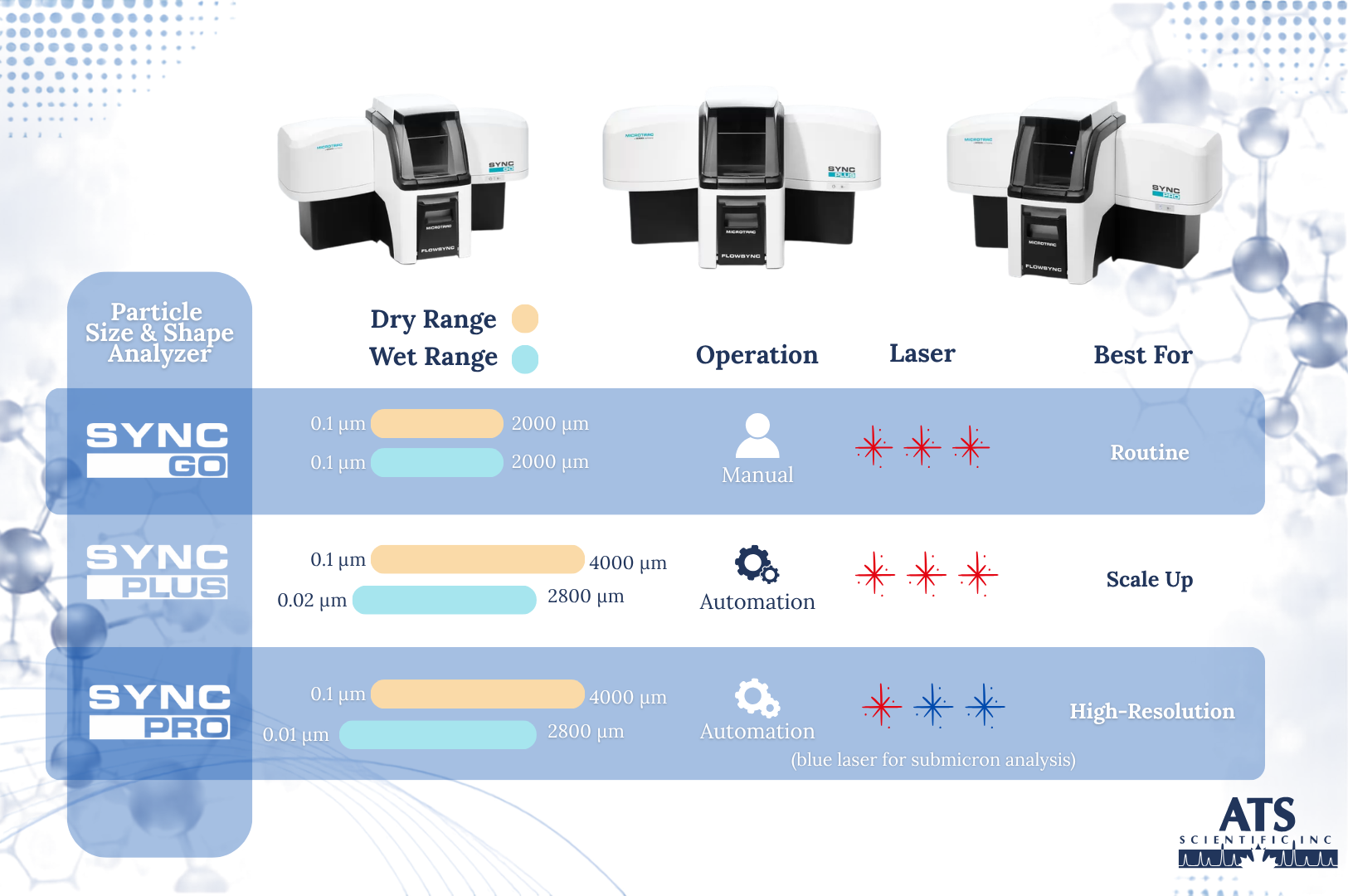
This guide compares the MICROTRAC SYNC GO, SYNC PLUS, and SYNC PRO to help you identify which level of particle size analysis best fits your application.
- If you are performing routine particle size testing → Choose SYNC GO
- If you are scaling up particle characterization → Choose SYNC PLUS
- If you need high-resolution particle characterization → Choose SYNC PRO
What Do All SYNC Models Have in Common?
All three SYNC models combine Laser Diffraction and Dynamic Image Analysis (DIA) in one platform.
Laser Diffraction measures the particle size distribution across a broad range, helping you understand how fine or coarse your material is.
Dynamic Image Analysis captures images of individual particles, providing information about particle shape and morphology.
The SYNC Series synchronizes particle size and shape measurements, allowing both sets of information to be analyzed together.
This gives you a more complete picture of your material, not just how large the particles are, but also what they look like.
How to Test Particle Size for Routine Applications — SYNC GO
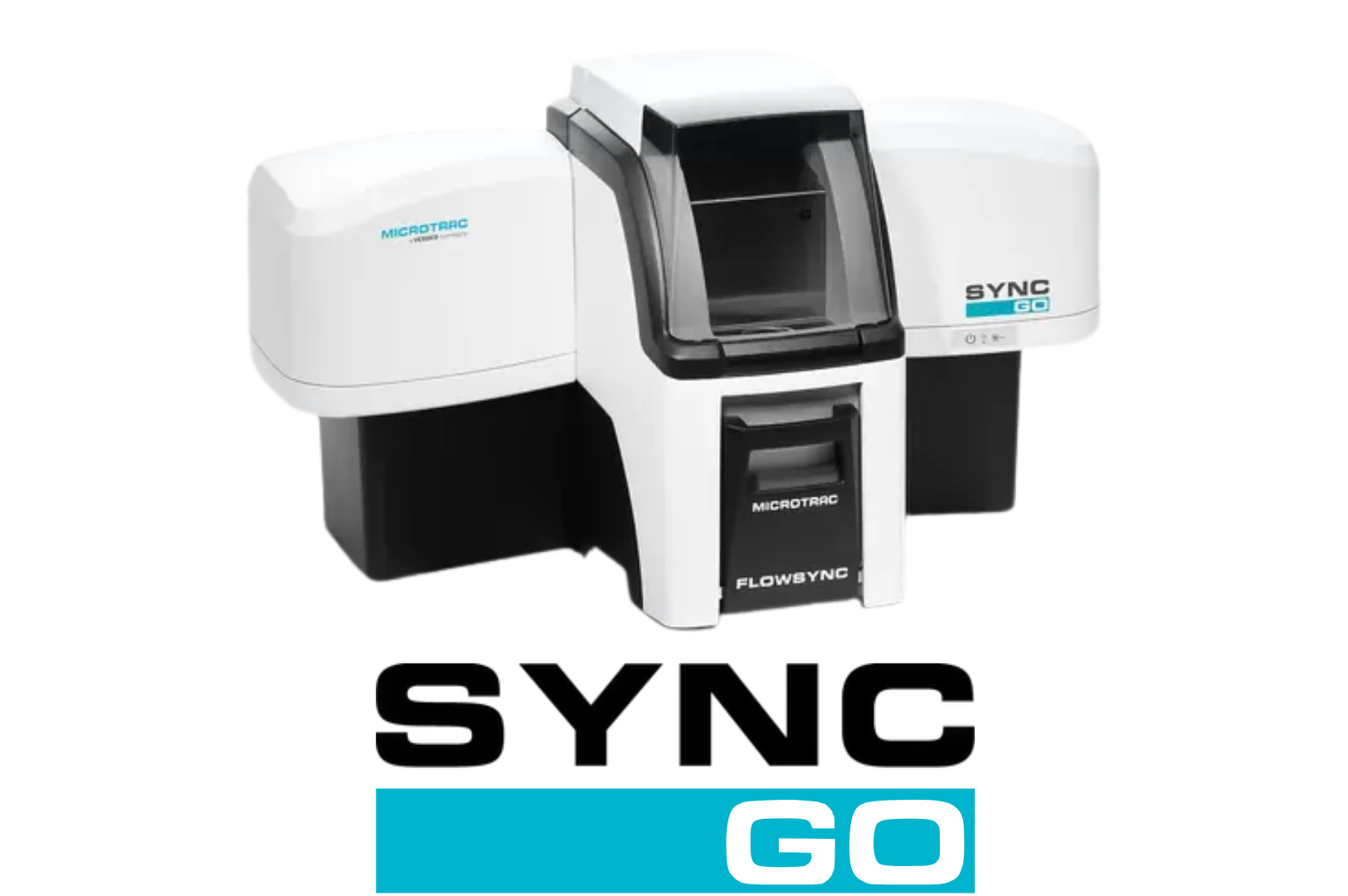
If your main goal is to measure particle size routinely, start by looking at the typical size of your samples.
The SYNC GO measures particles from 0.1 to 2,000 µm in both wet and dry measurements. This covers a broad range of common materials, including many powders, pigments, ceramics, construction materials, and industrial minerals.
For example, if your laboratory routinely checks whether a processed powder meets a particle size specification, you may not need an analyzer designed for extremely small particles.
The key question is: Does your normal sample population fit within the measurement range you need?
For routine material characterization, choosing an analyzer that comfortably covers your actual samples can be more practical than selecting the model with the widest possible specifications.
How to Scale Up Particle Characterization — SYNC PLUS
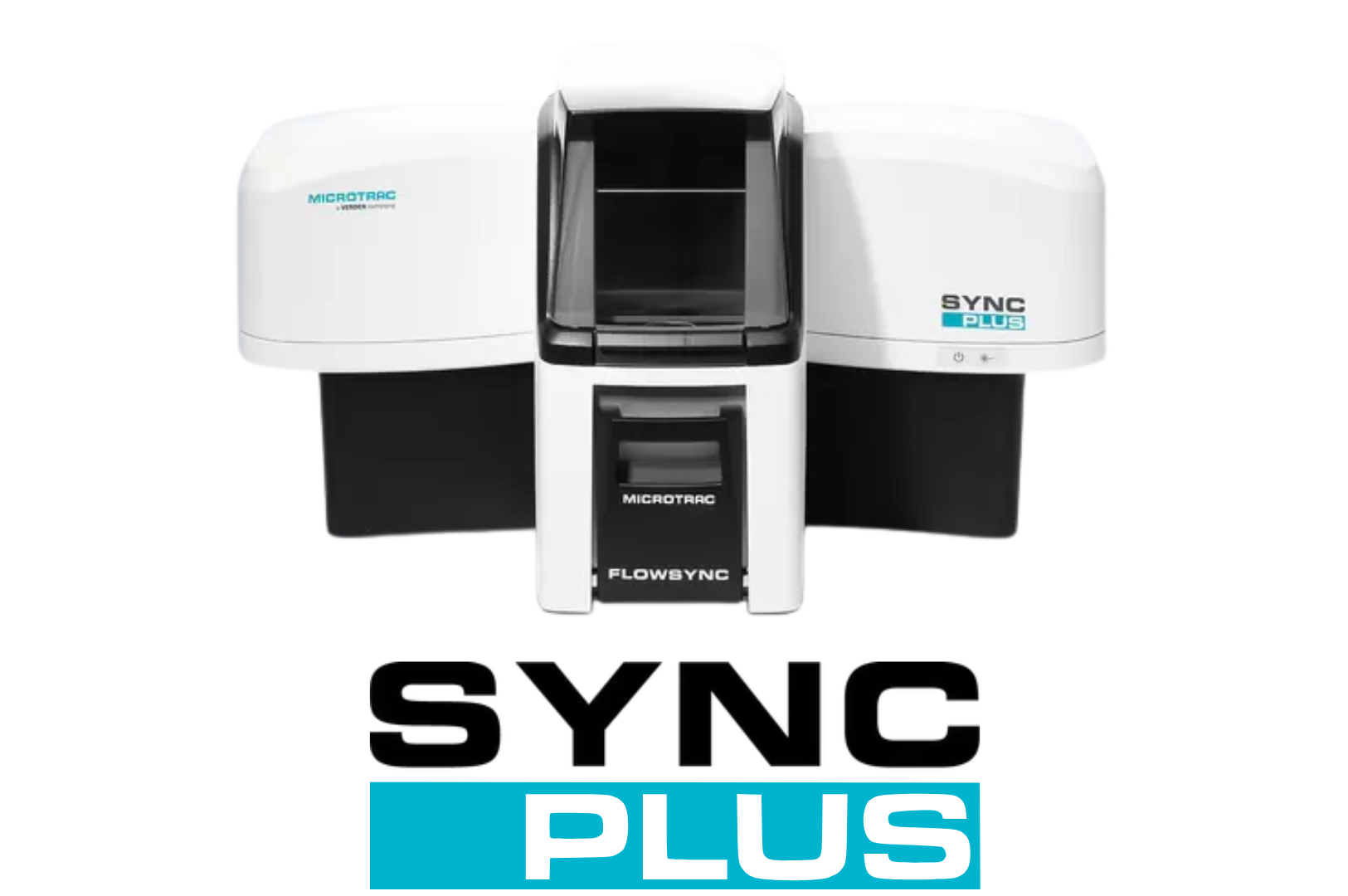
As laboratory needs grow, the question can shift from “Can I measure this sample?” to “Can I measure more samples efficiently?”
The SYNC PLUS expands the measurement range to 0.1–4,000 µm for dry measurements and 0.02–2,800 µm for wet measurements, while adding automatic operation.
This can be useful when working with materials that have a wider particle size distribution or when sample throughput is increasing.
For example, a powder-processing laboratory may begin with occasional measurements during development but later need to characterize samples from multiple production batches. In this situation, a wider measurement range and automated operation can help accommodate a more demanding workflow.
When evaluating your needs, consider both the size range of your material and the number of samples your laboratory needs to process.
How to Perform High-Resolution Particle Characterization — SYNC PRO
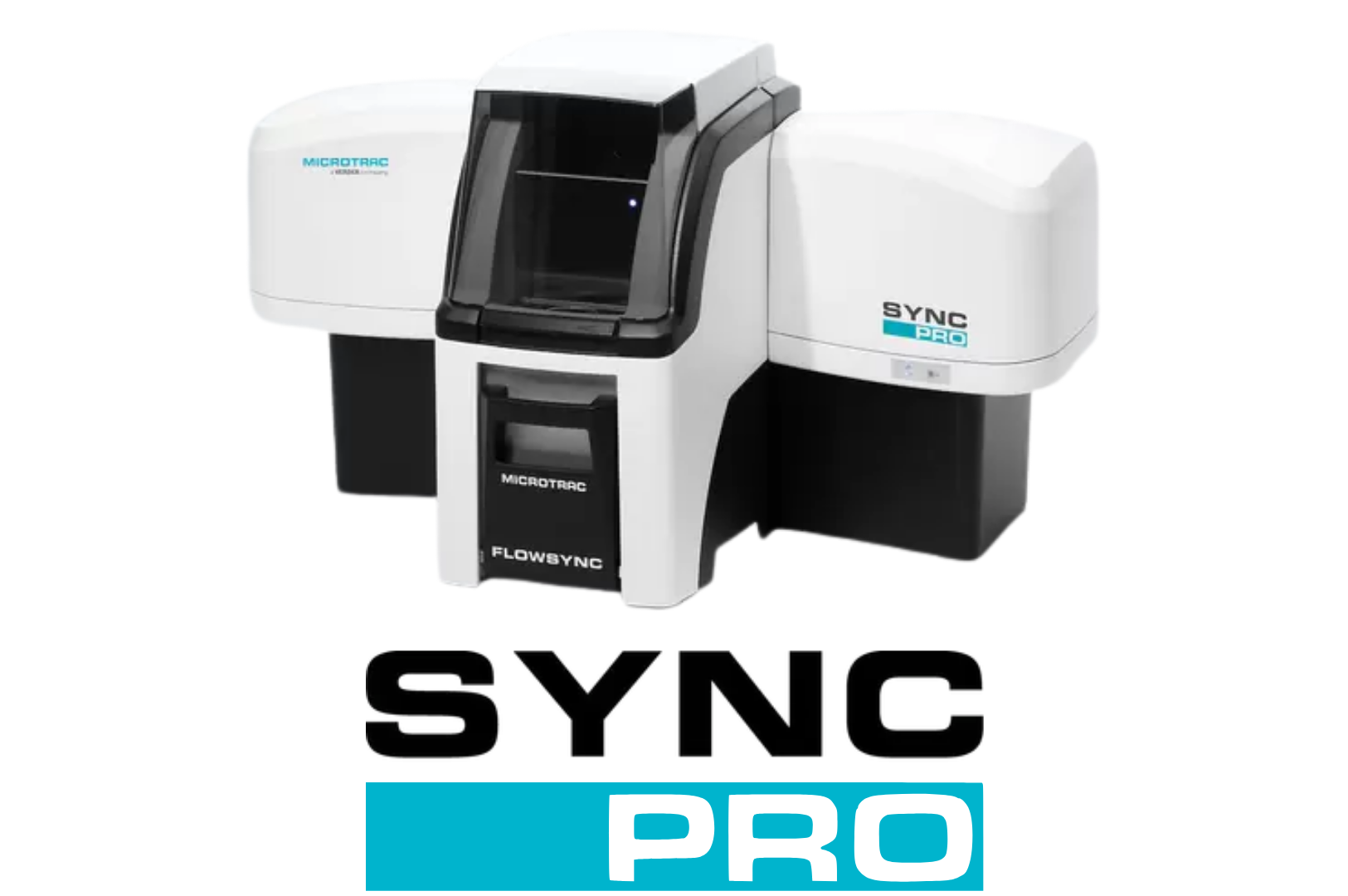
When your application involves very fine or sub-micron particles, particle size measurement requires greater sensitivity and resolution.
The SYNC PRO measures wet samples down to 0.01 µm and uses red and blue lasers to improve sensitivity for sub-micron analysis. This makes it suitable for applications where particles below 1 µm can have an important impact on material performance.
For example, fine powders, pigments, emulsions, and battery materials may require more detailed characterization of their smallest particles.
If your laboratory needs to distinguish and characterize particles at the sub-micron level, a higher level of measurement capability may be necessary.
Don't Choose Based on Specifications Alone
Particle size analysis is part of a larger process of material processing and characterization. The information you need depends on what happens before and after the measurement.
The best choice is ultimately determined by your material, particle size range, sample volume, workflow, and characterization goals.
Instead of asking “Which analyzer has the most features?”, start with these useful questions:
- What particle sizes are actually present?
- Dry, wet, or both?
- Are sub-micron particles important?
- How many samples?
- Would automation help?
- Is particle shape important?
These answers will point you toward the level of particle characterization your laboratory actually needs.