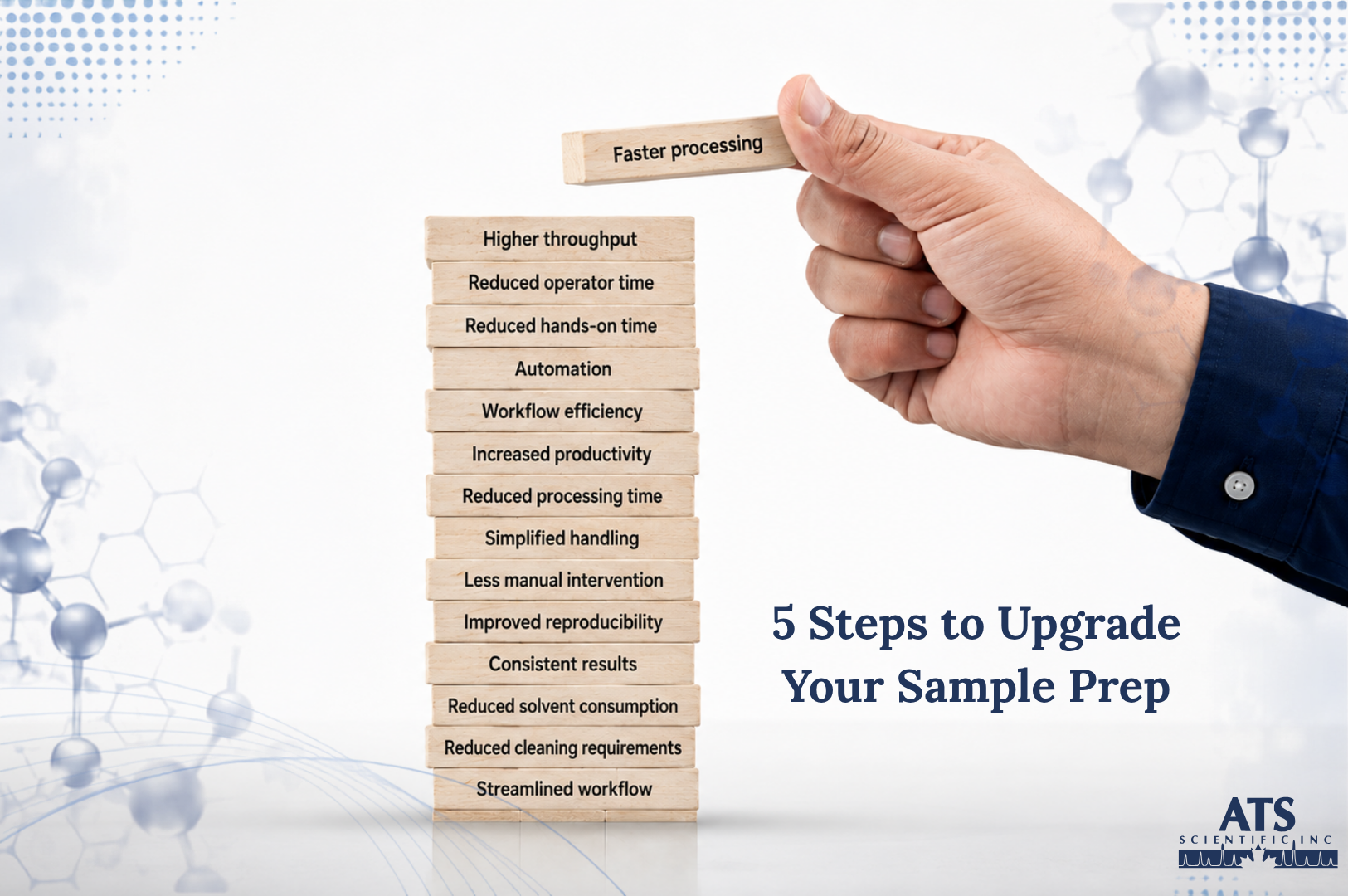
Improving the first step of analysis can improve the entire workflow.
Sample preparation is an important part of laboratory analysis. Before a sample can be analyzed, it may need to be reduced, separated, thermally treated, extracted, or digested depending on the material and analytical method.
When these steps are slow, inconsistent, or labor-intensive, they can create bottlenecks that affect the rest of the workflow.
A typical sample preparation workflow may include:
- Grinding → Reduce sample size and improve homogeneity
- Sieving → Separate particles into defined size fractions
- Thermal Treatment → Modify or condition materials under controlled temperatures
- Extraction → Isolate target compounds from complex matrices
- Digestion → Convert samples into a suitable solution for elemental analysis
1. Grinding: Create a More Consistent Starting Sample
Large, irregular samples can be difficult to process consistently. Manual grinding can also be time-consuming and may produce variable particle sizes.
Grinding reduces the sample to a more suitable particle size and helps improve sample homogeneity, creating a better starting point for subsequent processing or analysis.
RETSCH Mill
- Designed for efficient sample size reduction
- Helps produce more uniform particle sizes
- Supports controlled and reproducible grinding
- Available with different configurations for different sample types
- Can accommodate a range of laboratory sample materials
- Achieve faster and more consistent size reduction with better control over grinding conditions.
2. Sieving: Control Particle-Size Fractions
After grinding, samples can contain particles across a wide range of sizes. Without controlled separation, it can be difficult to obtain a consistent fraction or compare samples accurately.
Sieving separates the material into defined particle-size ranges, making it useful for quality control, classification, and subsequent processing.
RETSCH Sieve Shaker
- Supports dry and wet sieving
- 3D sieving motion
- Provides controlled and repeatable separation
- Suitable for larger sample quantities
- Improve particle-size classification with controlled and reproducible sieving.
3. Thermal Treatment: Control the Conditions
Some materials require heating before analysis or further processing. Other heating methods may not provide the temperature uniformity, atmosphere control, or flexibility required for reproducible treatment.
Controlled thermal processing helps ensure that the sample experiences consistent temperature and treatment conditions.
Carbolite Gero Furnace
- Can support a range of heating applications
- Excellent temperature uniformity
- Multiple tube diameters and heated lengths
- Available in different configurations and sizes
- Optional vacuum or modified-atmosphere operation
- Gain better control and repeatability during thermal treatment.
4. Extraction: Recover Target Compounds Efficiently
Environmental samples such as soil and sediment can contain target compounds that need to be separated from the sample matrix before analysis.
Traditional extraction methods can require long processing times, significant solvent volumes, and extensive vessel cleaning, creating additional work for laboratory operators.
Milestone Microwave Extraction System
The ETHOS X uses microwave-assisted extraction to accelerate the extraction process while reducing solvent consumption.
- Uses microwave-assisted extraction
- Accelerates the extraction process
- Reduces solvent consumption
- Contactless temperature control
- Designed for environmental matrices such as soil and sediment
- Speed up extraction while reducing solvent use and simplifying sample handling.
5. Digestion: Prepare Samples for Elemental Analysis
Complex samples often cannot be introduced directly into an elemental analyzer. They first need to be converted into a suitable solution through digestion.
Traditional closed-vessel digestion can involve multiple vessel assemblies, extensive handling, vessel cleaning, and potential memory effects.
Milestone Microwave Digestion System
- SRC systems → suited for higher-throughput workflows and larger sample batches
- Rotor-based systems → suited for routine digestion and individual vessel processing
- Controlled temperature and pressure conditions
- Supports digestion of a wide range of sample matrices
- Increase digestion throughput while reducing hands-on work and vessel-cleaning requirements.
Choosing the right microwave digestion system depends on multiple factors, including sample type, throughput, and workflow requirements. Read our blog, “How to Choose the Right Microwave Digestion System” to learn more about selecting the right system for your laboratory.
Upgrade Your Sample Preparation
Sample preparation is not a single process. Different samples require different solutions, and each stage can present its own challenges.
From size reduction and particle classification to thermal treatment, extraction, and digestion, upgrading the right step can help improve efficiency, consistency, and operator time.
With solutions across different stages of sample preparation, ATS Scientific helps laboratories build a workflow around their sample, not force every sample into the same process.