
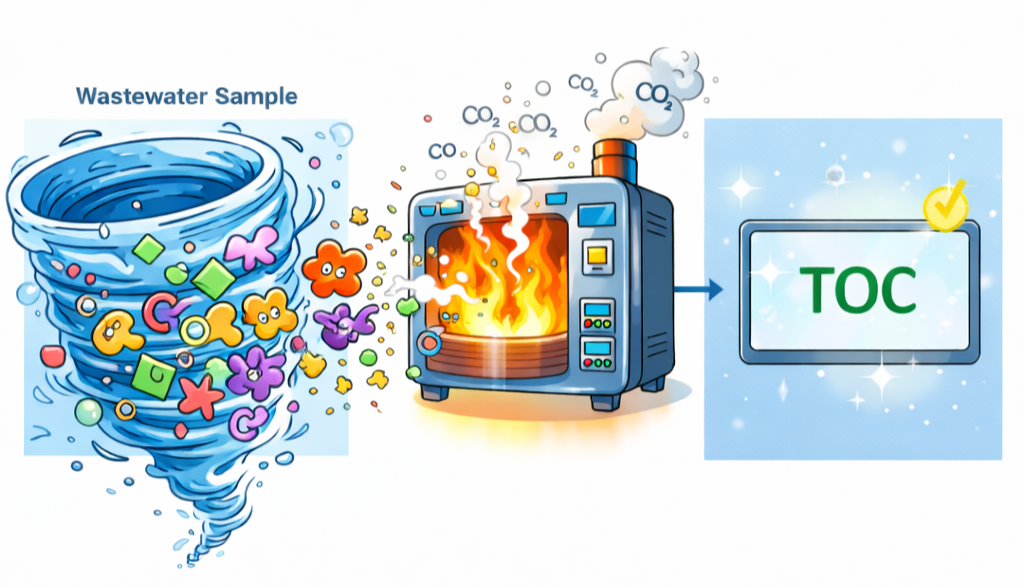
There is no doubt that water is the most fundamental ingredient for life. In wastewater monitoring, Total Organic Carbon (TOC) plays a central role in safeguarding quality. Unlike targeted analyses that focus on individual compounds, TOC provides a single, comprehensive indicator of organic material present in a sample. That simplicity is precisely why TOC is so widely used, and why the efficiency and reliability of the measurement itself matter.
Why Wastewater Labs Care About TOC
Wastewater contains organic material from diverse sources, including domestic waste streams, industrial discharge, and biological treatment processes. These organic compounds are often present in complex mixtures and at concentrations that make individual compound identification impractical for routine monitoring.
TOC addresses this challenge by acting as a summary measurement, reflecting the total amount of organic carbon dissolved in water. As a result, it is commonly used to assess overall organic load, monitor treatment efficiency, identify process upsets, and support regulatory compliance.
Elevated TOC levels can indicate increased treatment demand and may correlate with downstream environmental risks. For wastewater laboratories, TOC offers a fast and defensible way to determine whether organic pollution levels are changing, even when the precise source is unknown.
What TOC Is Actually Measuring
TOC analysis is not about identifying specific chemicals. It is about quantifying carbon. In high-temperature combustion TOC analysis, inorganic carbon is first removed from the sample. The remaining organic carbon is then oxidized to carbon dioxide (CO₂), which is measured and reported as TOC. Because all organic compounds contain carbon, this approach captures the full organic load regardless of chemical structure.
This is why TOC is often described as a “big-picture” measurement: it does not explain what the organic compounds are, but it reliably indicates how much organic material is present overall.
Where TOC Measurement Becomes Challenging
While the analytical principle is well established, wastewater samples present a practical challenge: TOC concentrations can vary widely, even within a single batch. Traditional TOC workflows often respond to this variability with multiple calibration curves, frequent sample dilution, and method changes during runs. These steps increase operator workload, extend analysis time, and reduce throughput. Over time, a measurement intended to simplify water quality assessment can become a workflow bottleneck.
Our Solution: The Lotix High-Temperature Combustion TOC Analyzer
The Teledyne Tekmar Lotix high-temperature combustion TOC analyzer is designed to support a wide dynamic range within a single analytical method. Lotix enables laboratories to analyze both low- and high-TOC wastewater samples without frequent dilution or method switching.
Its high-temperature combustion approach ensures complete oxidation of organic carbon, while stable sample introduction and sensitive CO₂ detection support reproducibility across varying matrices. By combining robustness, precision, and operational simplicity, Lotix helps transform TOC analysis from a variable, multi-step process into a more consistent and streamlined routine.
Range, Precision, and Sensitivity
The Lotix system maintains linear, reproducible TOC analyses across a wide concentration range using a single analytical method. Accurate performance is demonstrated from 0 to 20,000 ppm with one injection volume, reducing the need for multiple calibration curves or routine dilution.
Precision across this range remains within method expectations, with %RSD values typically less than 2%, supporting reliable compliance reporting and trend analysis. At the same time, sensitivity is preserved, with a method detection limit of approximately 50 ppb enabling confident measurement of low-level effluent samples within the same workflow.
What This Means for Wastewater Laboratories
For wastewater laboratories, this combination of range, precision, and sensitivity simplifies TOC analysis. Fewer calibrations, less dilution, and reduced method adjustments translate into shorter setup times and more predictable throughput.
Instead of managing multiple analytical paths, laboratories can maintain a single, consistent TOC approach across varying sample types, improving efficiency without compromising data quality.
A detailed evaluation of these performance results under wastewater conditions is presented in the accompanying application note.
Find the application note here.