
In soil and sediment analysis, analytical confidence depends not only on how samples are collected, but on how effectively they are prepared. Once primary size reduction is complete, fine milling and homogenization determine whether analytical subsamples truly represent the original material.
For laboratories handling soils, sediments, and related solid materials, fine milling must balance analytical fineness, sample integrity, contamination control, and throughput. This article outlines the key considerations for fine milling in environmental testing workflows.
The challenge of fine milling heterogeneous materials
Environmental laboratories routinely process samples with widely varying compositions. Soil and sediment materials may combine mineral particles, organic matter, fibrous components, or abrasive solids within a single batch. Achieving uniform particle size reduction and homogenization under these conditions is inherently challenging.
At the same time, many environmental analyses involve volatile components or trace-level measurements. Excessive heat generation during grinding can cause the escape of these compounds, introduce variability and reduce confidence in analytical results. Effective fine milling therefore requires high energy input combined with precise control.
Why high-energy milling matters
Fine milling serves two essential purposes:
- Reducing particle size to meet analytical requirements
- Homogenizing the sample to enable representative subsampling
High-energy milling allows both goals to be achieved within short, repeatable grinding cycles. This limits sample heating, reduces preparation time, and supports consistency across large numbers of samples, all critical factors in high-throughput environments.
Planetary ball milling in environmental testing
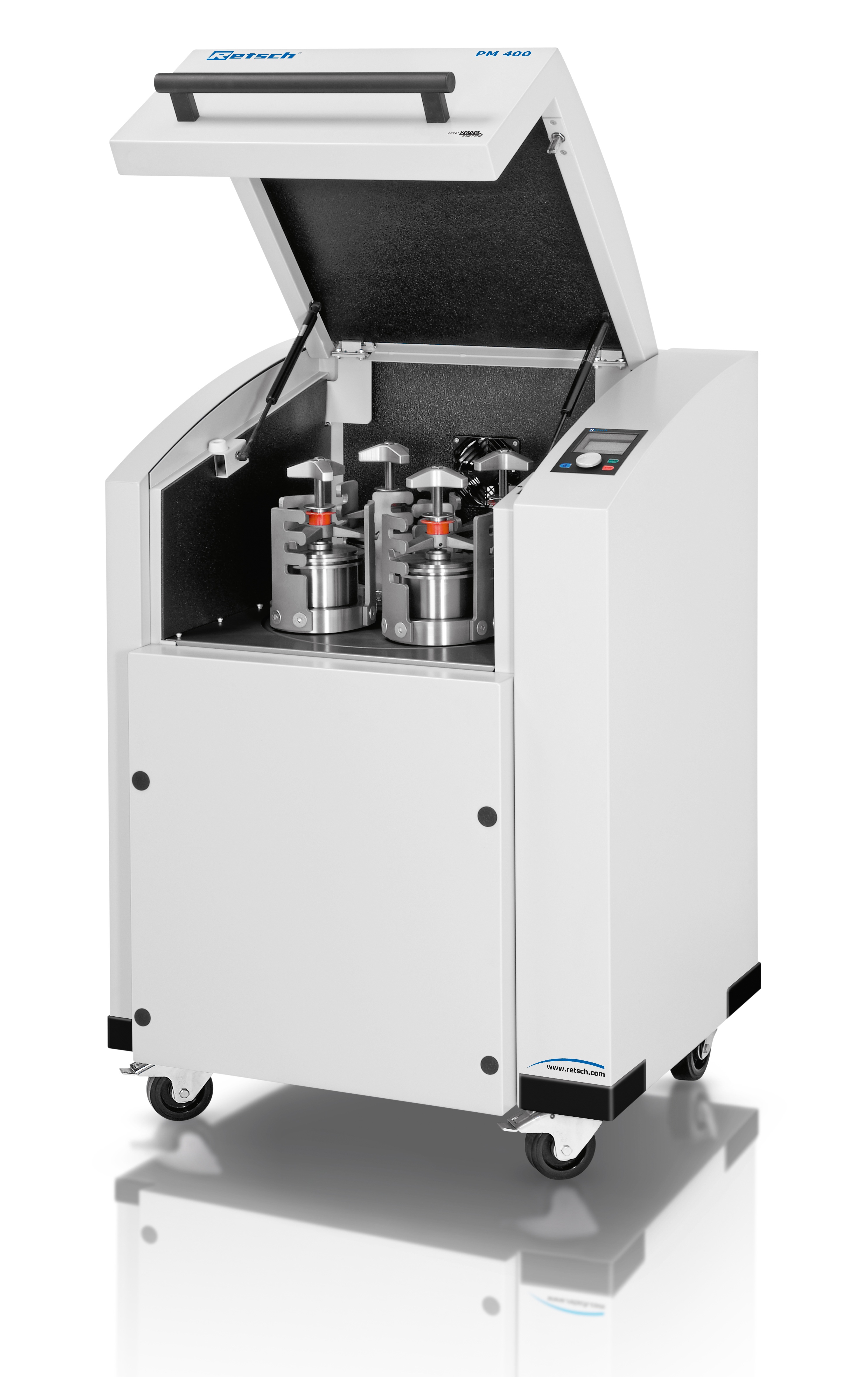
Planetary ball mills combine high grinding energy with controlled milling conditions, making them ideal in soil and sediment analysis. The Retsch PM 400 Planetary Ball Mill is an example of a system designed to meet these requirements in environmental laboratories.
Featuring four grinding stations operating simultaneously and rotating up to 400 rpm for the sun wheel, the PM 400 generates high energy density suitable for demanding size reduction tasks. With programmable grinding cycles, including adjustable run times, direction reversal to minimize caking, and interval cooling breaks, the system enables precise control over milling intensity and thermal load.
The PM 400 supports efficient throughput while maintaining reproducible milling conditions. High grinding energy enables samples to reach analytical fineness within short grinding times, helping to limit temperature increases during preparation. The availability of different jar materials and volumes also allows adaptation to specific sample types and contamination requirements. This is particularly important when processing materials that may contain volatile or organic components.
The ability to handle a wide range of materials, including hard, abrasive, soft, or fibrous samples, combined with robust construction and integrated safety features such as imbalance monitoring and automatic lid locking, makes planetary ball milling well suited to the variability encountered in soil and sediment testing.
Supporting reproducibility and long-term reliability
Consistent analytical results depend on reliable sample preparation, including stable milling conditions and predictable performance over time. Fine milling systems designed for laboratory use must support repeatable workflows while minimizing downtime and maintenance demands.
By delivering reproducible particle size reduction and effective homogenization, fine milling approaches such as planetary ball milling help laboratories maintain confidence in analytical data across different sample types and testing campaigns.
Fine milling as part of a scalable workflow
Fine milling does not operate in isolation. It builds on controlled primary size reduction and supports downstream analytical methods by providing homogeneous, representative samples. When fine milling is optimized, laboratories benefit from improved data quality, reduced rework, and more efficient use of analytical instrumentation.
As environmental testing demands continue to grow, attention to fine milling and homogenization remains essential for building reliable, scalable soil and sediment analysis workflows.
Are you looking to optimize fine milling in your soil or sediment workflow?
Our team can help you evaluate the right milling approach for your application. Contact us to discuss your requirements.