
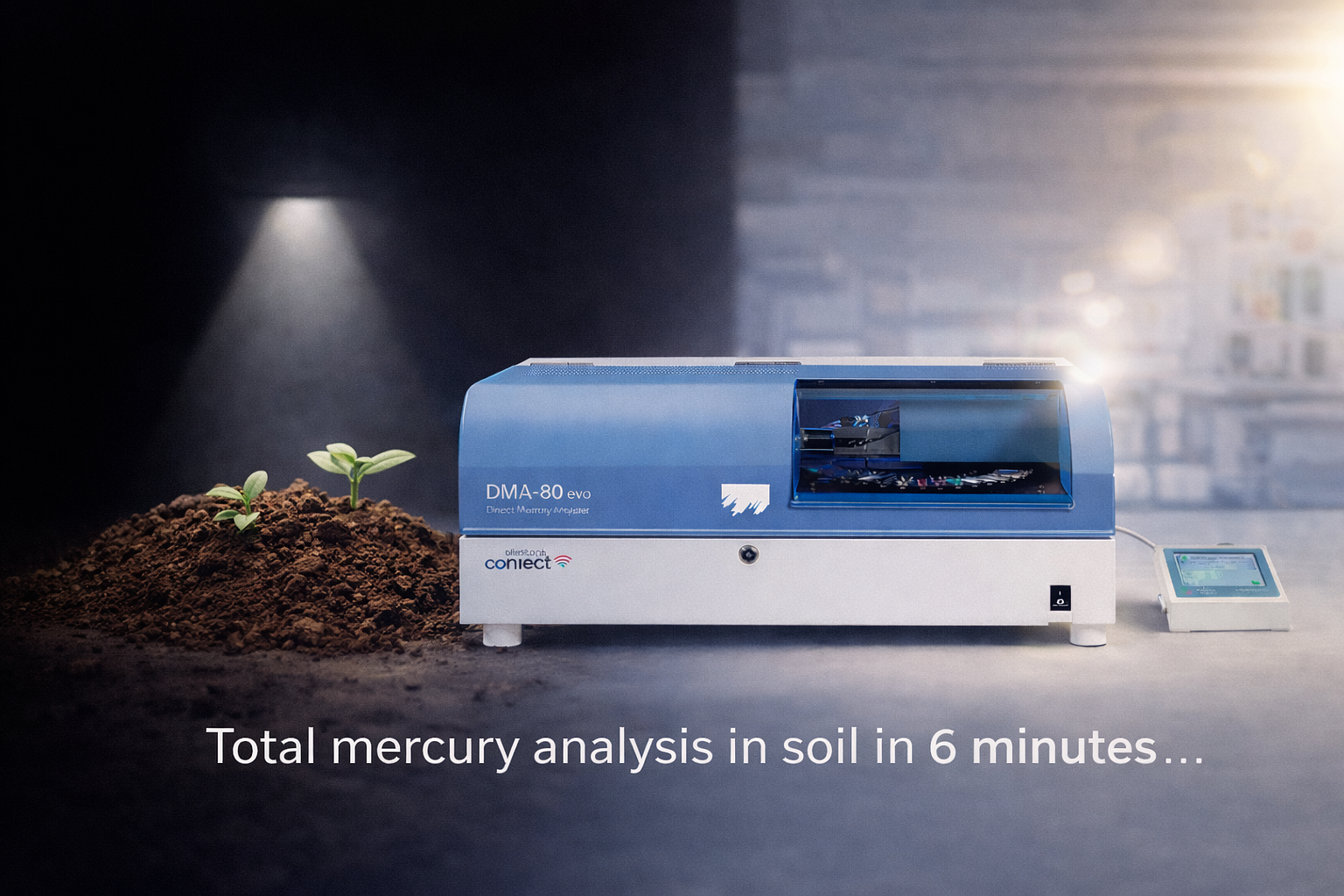
Of all the natural attributes of Earth that make our planet undeniably unique and, hitherto, one of a kind, Earth’s soil is perhaps one of the most fragile and precious natural resources, holding its head high along with our atmosphere and water. Together, they’ve made life possible and allowed it to thrive. An important medium, soil plays a crucial role in environmental and agricultural systems, promoting plant growth, providing food, fuel, and hosting immense biodiversity. However, soil also acts as both a sink and a pathway for contaminants introduced through natural processes and human activity.
Among these contaminants, mercury remains perhaps one of the most closely monitored, exposure to which impacts fetal development, cognitive function, and motor skills. Additionally, mercury in the ecosystem is transformed into methylmercury via microbial activity, which in turn bioaccumulates, as well as biomagnifies, going up the food pyramid on a destructive path, harming fish, birds, and mammals.
While mercury can be naturally present in soil, its concentration is often elevated through burning fossil fuels, industrial waste discharge, or by-products of industrial processes. Therefore, now more than ever, public and private entities are interested in measuring mercury in the soil and taking deliberate actions such as excavation, remediation, or disposal of the contaminated soil.
The challenges of mercury analysis in soil
Mercury determination in soil has traditionally relied on analytical techniques such as cold vapor atomic absorption (CVAA) and ICP-based methods. While well established, these approaches typically require elaborate sample preparation steps, are cumbersome, expensive, and take a long time to perform.
Additionally, wet chemistry techniques generate hazardous chemical waste and increase the complexity of laboratory workflows. For environmental laboratories handling large numbers of soil samples, these challenges can significantly impact throughput and turnaround time.
As regulatory monitoring increases, laboratories are under growing pressure to deliver reliable mercury data more efficiently, without compromising analytical quality.
Direct mercury analysis as an alternative approach using the DMA-80 evo
Direct mercury analysis, as described in EPA Method 7473, ASTM method D-6722-01 and D-7623-10 offers a streamlined alternative to traditional wet chemistry techniques. This method allows solid and liquid samples to be analyzed directly, eliminating the need for acid digestion or chemical conversion of mercury prior to analysis.
The DMA-80 evo applies a fully automated analytical sequence that includes thermal decomposition, catalytic conversion, amalgamation, and atomic absorption spectrophotometry.
Soil samples are introduced into quartz or nickel sample boats. The samples are first dried, and then thermally decomposed via controlled heating stages. The decomposition products are carried via a continuous flow of oxygen and passed through a heated catalyst bed where interfering compounds such as halogens, sulfur dioxides, and nitrogen are removed. Once all mercury species are reduced to Hg(0), they are then selectively trapped on a gold amalgamator and rapidly released into a single-beam atomic absorption spectrophotometer, where absorbance is measured at 253.7 nm as a function of mercury concentration.
The DMA-80 evo features a double beam, which significantly improves the signal-to-noise ratio, making measurements at ppt level possible. The method does not require conversion of mercury into ionic form, and so both solid and liquid matrices can be directly analyzed. Total analysis time is approximately six minutes per sample, significantly faster than traditional wet chemistry methods. Moreover, there is no need for acid digestion, chemical reagents, and no mercury-contaminated waste is created. Additionally, unlike conventional methods, no day-to-day calibration is needed, as the calibration of the DMA-80 evo is long-lasting for many types of matrices, over a wide concentration range: from ppt to ppm.
Case study: Total mercury determination in soil samples
The Milestone DMA-80 evo Direct Mercury Analyzer was evaluated for the determination of total mercury in environmental samples, including soil, sediment, and wastewater, with the goal of assessing both analytical performance and workflow efficiency.
To evaluate performance, soil and groundwater samples were obtained from an independent contract laboratory that had previously analyzed the samples using CVAA. Samples were analyzed using the DMA-80 evo at varying sample weights, depending on matrix type.
The results obtained using the DMA-80 evo showed good agreement with previously reported CVAA results across a wide range of mercury concentrations. Measured values for certified reference materials fell within stated uncertainty ranges, demonstrating reliable analytical performance for soil matrices.
Benefits for environmental and soil laboratories
The evaluation demonstrates that direct mercury analysis using the DMA-80 evo provides a reliable and efficient alternative to traditional wet chemistry techniques for soil analysis.
Key advantages observed include:
- No sample preparation or acid digestion
- Reduced hazardous waste generation
- Total analysis time of approximately six minutes per sample
- Accurate and reproducible results across soil concentration ranges
- Suitability for high-throughput environmental laboratories
By simplifying workflows and reducing analysis time, direct mercury analysis enables laboratories to respond more effectively to increasing regulatory and monitoring demands.
A streamlined path forward for soil mercury analysis
Accurate determination of total mercury in soil is essential for understanding contamination levels, supporting remediation efforts, and ensuring regulatory compliance. Direct mercury analysis using the DMA-80 evo offers laboratories a faster, cleaner, and more reliable approach that aligns with the evolving needs of environmental testing.
By eliminating sample preparation steps and reducing analytical complexity, laboratories can improve efficiency while maintaining confidence in their mercury data.
Click here to read the full case study: