
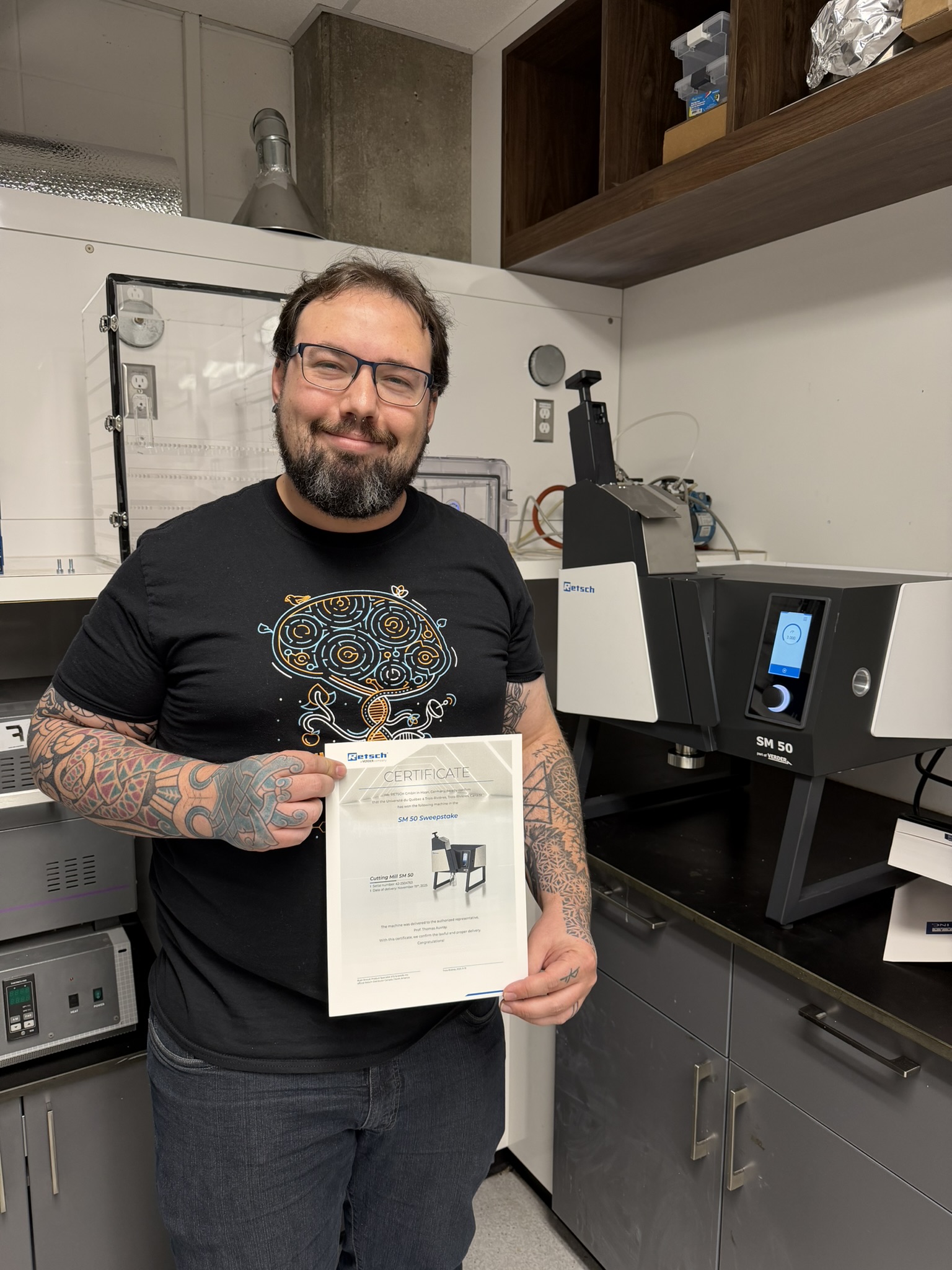
Université du Québec à Trois-Rivières (UQTR) researcher, Professor Thomas Auvray, recently received a brand-new Retsch SM 50 cutting mill through an Retsch giveaway. We spoke with Professor Auvray about his reaction to winning, his emerging research program, and how this new instrument will support his work in sustainable chemistry.
ATS:
Professor Auvray, could you please introduce yourself?
Prof. Auvray:
I'm Thomas Auvray, a professor of chemistry at the Université du Québec à Trois-Rivières. I’m thrilled to have received this brand-new SM 50 from Retsch.
ATS:
How did you feel when you won?
Prof. Auvray:
It was awesome! I started my faculty position a year ago, and I got the news within my first six months as a PI (note: principal investigator). I’m a brand-new PI with no equipment in the lab yet, and then I suddenly had this instrument to get started. It fits perfectly into the research program we're developing. So it was amazing!
ATS:
Speaking of your research program, what are you working on?
Prof. Auvray:
The idea is to make chemistry more sustainable. We want to use mechanochemistry – the use of mechanical forces to create new materials in a more sustainable way, with less waste and lower energy consumption. This approach applies both to making new materials and reusing materials we already have.
ATS:
And how will the SM 50 integrate into your work and improve your process?
Prof. Auvray:
To do mechanochemistry, you need smaller, uniform material to start with, because the space in the milling jar is limited. The SM 50 will pre-prepare material in a very homogeneous way, allowing us to control the size of what we feed into our chemical processes. This will help us be more reproducible in developing our chemistry and better understand what happens with real objects. For example, now I can take a Falcon tube, shred it, and recycle the plastic.
ATS:
With that in mind, where do you see this going in the next one, three, or five years? What's next for you?
Prof. Auvray:
We're really excited about using mechanochemistry for urban mining – taking waste from daily life, such as plastics and electronic circuit boards, and recovering the metals inside, including precious metals that we may not mine in Canada. The goal is to turn them into feedstock for industry. I believe that in the next few years, we'll be able to develop this significantly and contribute to the circular economy, especially for batteries and similar technologies.
ATS:
Wonderful. Thank you very much, and congratulations again!
Prof. Auvray:
Thank you again for the instrument. I can't wait to play with it!
Watch the interview!